
Altera Reborn: A Pure-Play FPGA Company
Interview with CEO Raghib Hussain

This is a transcript from our video interview. You can check that out here or at the link below.
Whenever I talk about the land of compute, we imagine it as a line going from CPU to GPU, to FPGA then ASIC. If you want to talk about AI, it gets muddy somewhere in the middle! But one of the key things that I think people forget is that FPGAs exist.
FPGAs have been the lifeblood of this industry for decades. They are the reconfigurable compute that makes it so other chips can be designed and can be built. They’re also used a lot in systems where that reconfigurability enables new security to be added, or new features to be added in the life cycle. These parts typically exist in the environment for 10 to 15 years or more, allowing that consistent upgrade cycle in the reconfigurable hardware to happen.
Now, one of the biggest players in FPGAs since I’ve been covering this industry has been Altera. I covered Altera when it was acquired back in 2015/2016 by Intel for around $15 billion. We are now 10 years later, and Intel is divesting its ownership of Altera. An investment fund called Silver Lake is buying 51% of the company, and Intel will retain 49%. It’s a position that allows Altera to be flexible, which is the interesting way of putting it. It means that they control their own destiny. It means they can decide what markets to go after, and we can get a true refresh and invigoration of the product stack, of the customer stack, and what lies in store for the world of FPGAs.
Joining me today to talk about Altera’s new options is CEO, Raghib Hussain. Thank you for joining me. Raghib and I know each other from Cavium and Marvell days back when ARM CPUs in the data center were the big thing. (I mean, they still are!). But I wanted to get Raghib’s viewpoint, especially as an outside entrant into Altera.
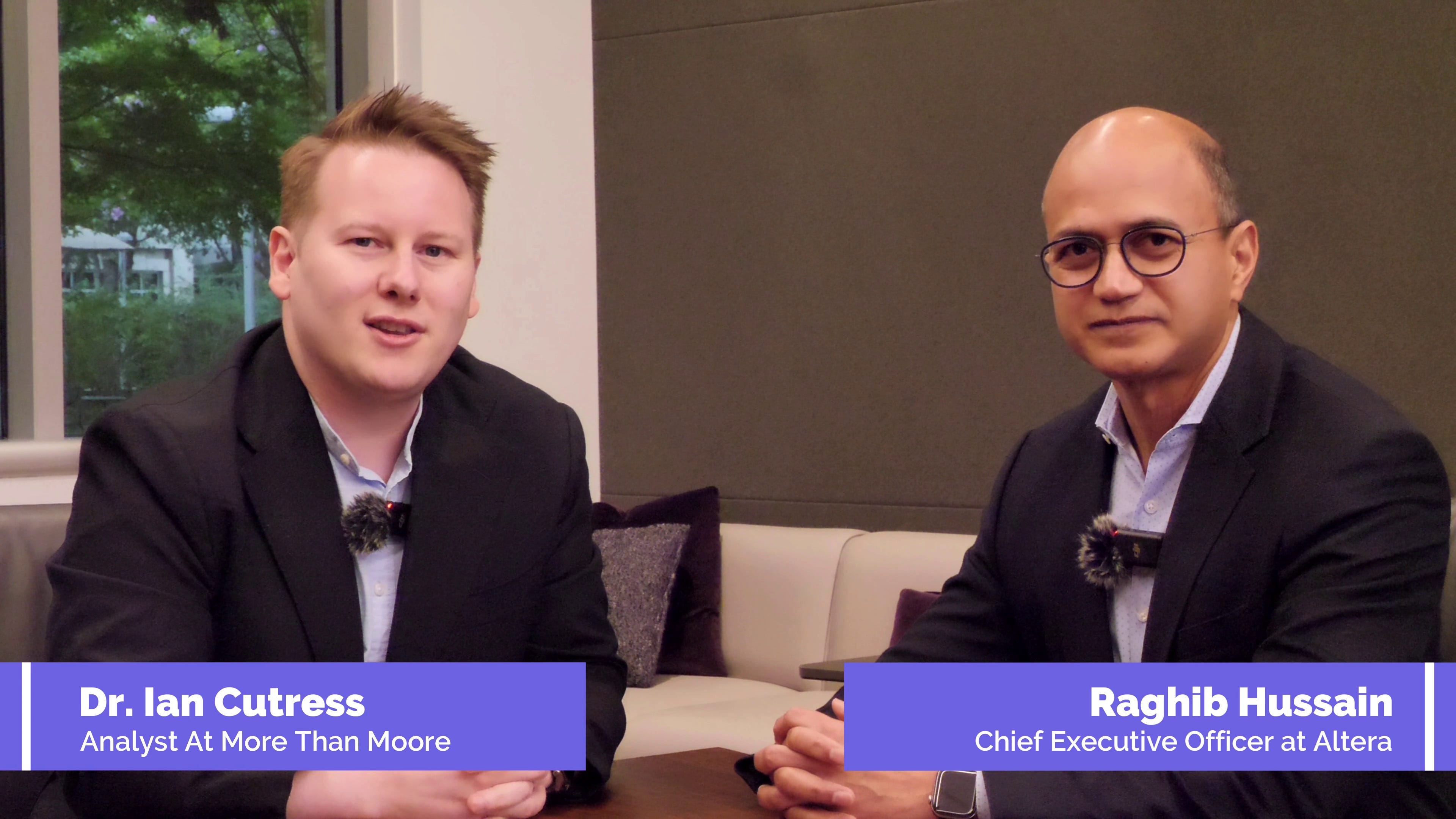
Ian Cutress: What does being outside and coming into a company with the history of Altera provide you?
Raghib Hussain: As you correctly said, FPGAs are a foundational technology needed for the broadest application of our infrastructure. Altera has been around for several decades and has always been driving innovation and bringing the best technology. However, under Intel, the focus was on certain segments, for the right reason.
Now, becoming independent, I believe we can bring the original value of Altera back in action. We can bring the focus back. This will be the largest pure-play independent FPGA company. With that, we have a lot of freedom.
First of all, coming from outside, I’m coming from the culture and what I’ve done throughout Cavium and Marvell, what I call, ‘The world revolves around the customer’. I am bringing that culture back to Altera and implementing this concept of focusing on solving the customer’s real problems. We want to focus on the broader FPGA market, which includes industrial, telecom, data center, audio, video, and the new, evolving robotics and edge AI. Those are the broader markets which match very well with the applications of the FPGA programmable devices.
It gives us full control to focus on what we want to do, how we want to do it, which foundries do we want to use, which process nodes do we want to select, and how we really take full control of extreme ownership of our destiny. Also control to deliver the best value for the customer.
Ian Cutress: How has your viewpoint changed from you being outside the company to you now being inside? You’ve been in the job what, about two or three months now?
Raghib Hussain: Four months, yeah. So, of course, before coming in, I worked very closely with Silver Lake to do the full analysis of the situation and the opportunity. But outside, you may not know how things are. In fact, what I have learned in the last few months is actually even more encouraging than what I was coming in with!
I’ll give you a specific example. For example, I did not know how good the basic core fundamental technology we have [at Altera[ is. Just to give an idea, the fabric is the key. I mean, how good of a fabric you have. Altera still has the best, highest performance fabric in the industry based on independent benchmarks which have been done. So, that is excellent.
But what also makes FPGAs very critical, the other component is how good are the tools, EDA tools and overall software that you have to enable that fabric to your customer. And throughout the several efforts that Altera team had done in the last few years, there was an initiative to substantially increase the tools and the EDA. What I learned is our compiler performance actually in latency time is better and is the leading in the industry. And also we have, on average, on the KPI basis, our usability and ease of use is very, very competitive and the best of the best in the industry.
So those are the interesting findings I did not know coming in. I also had concerns about how good of a team we have, because as you know, we (Altera) have been a part of a large company for the last 10 years. So things disappear over time. But again, I was pleasantly surprised that we have a really high-quality core team that is still very well committed to this company and this product group. So I’m really happy. I believe now, with what I felt like, that they were constrained because when you’re part of a big umbrella, a big corporate umbrella, you know, there can be many changing priorities and so on. But with this freedom, with being independent, we will be able to put our complete focus and drive the best out of this IP, this product, and this talent.
Ian Cutress: The news of Silver Lake coming in and taking 51% ownership now surprised us a little bit. As part of that, Silver Lake brought you in as CEO. This is an open-ended question, but honestly, what does it mean to the company, this process?
Raghib Hussain: I believe one of the reasons I partnered with Silver Lake and I like Silver Lake, is that they have a proven track record of partnering with management teams to create value in the long term.
There is a perception out there about private equity, how they just come and quickly milk the situation and make money and run away. If you look at Silver Lake’s track record, they are not like that. Wherever they invested, they were invested with the long term. And for the company and even for the customers and the employees, I think the most important aspect. It actually made me really excited about having this opportunity, to take it private, and to invest where investment is needed to fill the gaps and to really bring the solution to solve the customer’s real problems. We will have full control and full freedom to do that, which in many ways becomes difficult if you are a part of the large public company or the public company, because you have to manage quarter over quarter expectations and so on.
Here, as a strategic partner with Silver Lake, we can think on what makes sense for the company and for the business for the long-term health and growth. So it gives us this huge opportunity to invest in what is needed to be the leading provider of FPGA solutions for our customers.
Ian Cutress: The word I’ve been using externally is agility.
Raghib Hussain: I would say agility, nimbleness. The focus, and really nobody constraining you in any way, running with your fastest pace towards your common goal, towards your destiny.
Ian Cutress: Are you feeling that company-wide?
Raghib Hussain: Of course. The culture starts from the top. As I said, you have to model it, and it goes from there to the different levels of the company right from the first day. You know the team; you can ask them also. I am setting up the culture of a very transparent, very truthful, with very open communication. In fact, even in my all-hands, I do open mic, which was not the culture before I came here.
I am of the opinion that we are one team; we should be honest, direct, and more like a startup. I call it a very large startup. We need to be very well aligned. We need to be aligned on the goal, and we need to have extreme ownership. I’ll give an example: there are no swimming lanes here; we are all together in the ocean, and we have to all work together to bring the best to solve our customers problems and to create value for everybody. So I think the team has responded really well to that, and I am already seeing the level of energy and sense of excitement which is going on in the company is growing every day at a very fast pace.
Ian Cutress: Can you give us a breakdown of the size of the company now, and engineers versus support staff, just sort of a viewpoint so people can right-size where Altera fits?
Raghib Hussain: It’s close to 2500-2600 employees, about 2,000 of which are engineering. It’s a heavy engineering organization that we have. And then we do support, you know, a very diversified set of customers in the markets. We have the full stack product portfolio. And it’s not just the hardware - we have a very comprehensive set of solutions and the tools and the IPs that complement all those.
One of the initiatives that I’m driving, I want to, for the targeted market, bring much more kind of close to shrink wrap type of a solution. So our engineering team is already aligning with that, so that is important. Then of course, as Intel announced last year, our revenue was around $1.5 billion. So of course, this year is not announced, it’s not public, but it’s north of that.
So it’s a significantly sized company, and that’s why I’m saying it’s a very large startup. But the culture and the mindset that I want to drive here of extreme ownership and and really be living every day of, ‘hey, what did we improve today? How did we work together? How did we solve our customer problems today?’ I want everybody to be excited about it, and everybody brings their best to achieve this combined goal.
Ian Cutress: What in your background suits you for this role?
Raghib Hussain: I was a co-founder of Cavium and spent several years developing custom processors at Marvell. Our first interaction was actually during the Cavium days! So that was where we developed the “data plane processor” to solve the problems which we saw that growing data use will cause the industry.
In many ways, I find the parallelism between those products that we brought to the market and the solution that we had to provide and the FPGA market. So, for example, we had a diversified set of customers in many, many markets over there, ranging from embedded appliances, small home type of appliances all the way to data center or wireless telco infrastructure. Because we were bringing this new type of product, a multi-core processor with a bunch of hardware, but you could do many things on that based on the software and the application stack.
Initially, it was MIPS-based and then later on we translated into ARM. So that is a very similar type of solution that you have to provide for FPGAs as well. The way we made this successful is really getting close to the customer, understanding their problems and mapping our solution to solve their problem. And I think this is one of the initiatives I have done in the company ever since I came. I want to bring the customer’s engineering as close as possible because in my mind, a true company is either you are producing products or you are solving customers problems. So that’s the culture I am bringing. That’s why I said “a startup”.
Ian Cutress: With Cavium, you’re a startup with low double-digit customers, and you can closely align with those. The way I see an FPGA company is that you have 10,000 customers - how can you reconcile the ability to be close with 10,000 customers versus 10?
Raghib Hussain: So, one of the things, even in the processor, was we had many, many downstream customers that we did not even talk to directly. So we created an ecosystem over there of the software and the solution and IP, as well as the library stack and all that. So there are similarities in that an FPGA needs those by default.
So the key is how do you make the sales team and field team and the distribution field team really aware of the technical capabilities so that they can assist their end customer in an effective way. And then of course, in today’s world, there are other tools. Another initiative I started right away when I came here is how we can leverage AI to even improve that overall solution. That’s what we are focused on, and that’s why there is a lot of excitement in the company about how we scale even faster.
In my mind, this company is becoming independent at a very pivotal moment in history where Human AI or Edge AI or Physical AI, whatever you call it, is evolving right now. There are lots of sensors that are needed to transfer the information from the sensor to whichever is the compute central engine. There are a lot of different formats of data that need to be transformed in real time. Then there are security concerns. Those are the applications where FPGAs are the best fit because when the FPGAs are very good, when the actual application data thing is changing, and the latency is important. Or when the volume is not large enough to justify doing an ASIC because the development cost of ASIC is also rising with the latest nodes.
So the thing is if you want to get the best out of the best, in all these edge AI applications, especially the interface to the physical world, you need to have the application specific optimized solution. And this is where I’m already seeing customer traction and so much potential of growth, and I believe we are very well suited for all those applications. So I’m driving all those initiatives here.
Ian Cutress: One common thread throughout all of that, I think, was education. Not only education of the sales funnel but also education of the customer funnel. What can you do differently now as an independent?
Raghib Hussain: When you are part of the large company, the overall sales team and support team is a part of the big umbrella. It is really hard for them to go and do a focused product and focused market solution specific efforts. This is because if your total revenue is, let’s say, a hundred billion dollars - if this small thing has two or three billion, no matter what you do, you cannot really make a huge dent. This is where, for the right reason, management focus does not go on those things.
The beauty of being independent is because what our business is, with our focus, we can bring a lot of value, and we can actually come up with a very targeted, tailored solution and tailored training program that we can actually pass it on very effectively to the to the next layer and next layer and all the way to the end customers. So we can actually be very well focused for the customer’s needs.
Ian Cutress: One bit of feedback I always gave to Intel was about their developer kits. Can you explain how you’re going to introduce the products the company sells, and specifically ‘here’s how you can play with them’?
Raghib Hussain: When you are dealing with a customer who has their own thousand engineers doing things, you need a different type of developer kits. But when you’re dealing with a customer who probably only has one FPGA engineer who is going to use it and is going to deploy it, you need a different type of solution and training and a dev kit, right?. Our goal is to identify key market application segments and build market-focused dev kit solutions - which by the way is nothing new. Altera already has certain market-focused dev kit solutions; it’s just that they were not being positioned and given to the targeted customer before in an orderly manner.
We need to fine-tune those, and we need to take it to those customers so that they have a very pleasant experience, ease of use experience, and can quickly convert their ideas into the actual product. Because in the FPGA world, design wins and the actual volume production has a long lead time in-between, and whatever we can do to shorten that time is best for everybody. It’s good for the customer; and then it’s good for us for the faster time to revenue.
Ian Cutress: How do you see the next 3-6 months progressing for Altera?
Raghib Hussain: We have been moving at a very fast pace in the last three or four months since I joined, but we were a bit constrained because we were not a really independent company - but we will have full freedom moving forward. So I see us moving through different areas of focus, but it all revolves around the customer.
First is how can we actually take the existing product, existing dev kit, make it more easy to use and optimize for our customer. How can we bring better engineering support for our end customers so that they do not need to wait, and we are committed to supporting that.
Then we are improving our overall supply chain and operation so that we can actually do a better quality job and delivery and overall improve that process. So those are the things we are moving forward in.
And then in parallel, while all this is going on, we are improving the existing toolkit and software to improve ease of use for our customer. So that will be very effective for the customers who are picking up our new designs.
And then finally, I plan to not only streamline our roadmap, but we execute it with a lot of high quality but at the same time with a deterministic schedule. That is something that when you’re part of a large organization, and you are in a company that has 100 products to do, you kind of lose track of things. Here there’s only one thing we are doing. We are doing these FPGAs and focusing on our customer, so how we choose the features and how we productize fast is important in my opinion.
Then when I came here, the concept of ‘a new product line every 4 or 5 years’ was embedded. The world has changed - 12-15 months is the cycle time. I mean, you have to have to have new products at that pace. In fact, a bunch of veteran industry folks who have also joined me are bringing all those knowledge bases and culture to the team. We have very good traction internally; people are very keen to understand those processes. Many times in a large company, there are too many communication gaps and too many processes, so internally, I’m collapsing those and making it a very efficient, more of a daily sprint type of a process.
I’ll give you an example, I have, just like any other executive, weekly meetings, staff meetings, but I have this concept of daily morning sprint. I pretty much call most of my direct reports, and we quickly discuss top of mind issues. That way, by the time we get to the weekly meeting, most of the things are already known and discussed, and this weekly meeting is used more for collaboration and bringing focus together and so on. So many of those things I am encouraging the team also to do. It is the communication and execution, with excellence and extreme ownership, that is going to be a part of our culture and the customer focus to deliver value for them. We are going to drive in all cylinders to achieve that.
Ian Cutress: Is this the old Altera reborn, or is this a new Altera?
Raghib Hussein: I was not at old Altera, so I cannot comment about that. But at the same time, I know what a good semiconductor company should be, what should be the company focus, and what should we drive our teams to deliver. And as I said, it all revolves around the customer. Our whole reason for existence is to solve customer problems, right? So everything that I’m doing internally here is to drive that, and engineers actually love to do that. They get excitement out of when their product gets out, when their product gets shipped in real products out there, and solutions solving customer problems. They get excitement out of it. I’m an engineer, and I believe most engineers are that way. I am driving from every angle, and that is why I’m very excited. I’m sure we are going to do great!
Ian Cutress: It sounds to me like ‘old Altera, new attitude’!
If you’re interested in hearing more about Altera, do check out our Altera Innovators Day livestream where Raghib is going to be on stage presenting and hopefully we’ll get a few more insights into what exactly Altera is doing. It starts at 8:30am PT on September 30th over on YouTube.
Did Altera's new CEO share any information (or give hints) about which nodes and whose fabs they will use and plan to use now that they're no longer part of Intel ?